Synopsis
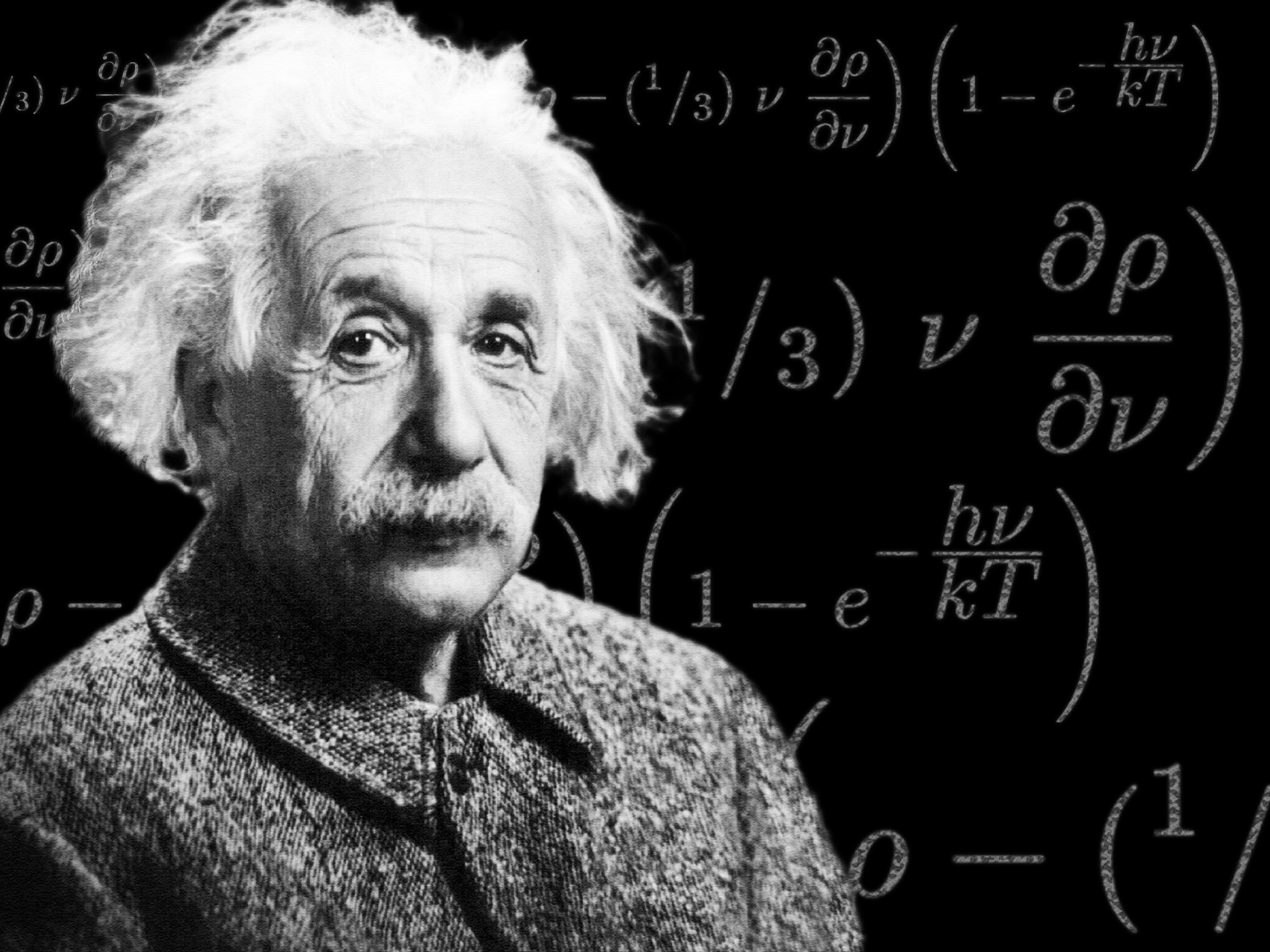
Born in Ulm, Württemberg, Germany in 1879, Albert Einstein had a passion for inquiry that eventually led him to develop the special and general theories of relativity. In 1921, he won the Nobel Prize for physics for his explanation of the photoelectric effect and immigrated to the U.S. in the following decade after being targeted by the Nazis. Einstein is generally considered the most influential physicist of the 20th century, with his work also having a major impact on the development of atomic energy. With a focus on unified field theory during his later years, Einstein died on April 18, 1955, in Princeton, New Jersey.

Everybody is genius. But if you judge a fish
by its ability to climb a tree,
it's
will live its whole life believing that it is stupid."
Timeline of Einstein's Life
- 1879
Born to Hermann Einstein (a featherbed salesman) and his wife Pauline in Ulm, Germany.
- 1884
Receives his first compass around this time, inspiring a lifelong quest to investigate mysteries of the natural world.
- 1889
Settles into a program of self-education at age 10 and begins reading as much about science as he can
- 1894
Stays on in Munich to finish the school year after his parents move to Pavia, Italy. Lasts only one term on his own and then follows his family to Italy.
- 1895
Attempts to skip high school by taking an entrance exam to the Swiss Polytechnic, a top technical university, but fails the arts portion.
His family sends him to the Swiss town of Aarau to finish high school. - 1896
Graduates from high school at age 17 and enrolls at the ETH (the Federal Polytechnic School) in Zurich.
- 1898
Falls in love with Mileva Maric, a Serbian classmate at the ETH.
- 1900
Graduates from the ETH.
- 1901
Becomes a Swiss citizen and, unemployed, searches for work. Meets Maric in northern Italy for a tryst, and she becomes pregnant. In the fall, he finds work in Schaffhausen,
Switzerland as a tutor. Maric, visibly pregnant, moves to Stein am Rhein, three miles upriver. She then returns to her parents' home to give birth to her child. Einstein moves to Bern. - 1902
In January, Maric gives birth to their daughter, Lieserl, whom they eventually put up for adoption. Lieserl reportedly becomes ill, and then all record of her disappears. Einstein takes a job at the Swiss Patent Office. Hermann Einstein becomes ill and dies.
- 1903
Marries Maric in January.
- 1904
Maric gives birth to their first son, Hans Albert.
- 1905
Publishes, at age 26, five groundbreaking papers, making this his "annus mirabilis," or miracle year. One of the papers introduces his special theory of relativity and another E = mc2.
- 1906
Continues working as an examiner at the Swiss Patent Office in Bern.
- 1907
Begins applying the laws of gravity to his special theory of relativity.
- 1910
Son Eduard is born.
- 1911
Moves with his family to Prague, where he is given a full professorship at the German University there. Attends the invitation-only Solvay Conference in Brussels, the first world physics conference; he is the youngest physicist there.
- 1912
Moves with his family to Zurich, where he becomes a professor of theoretical physics at the ETH.
- 1913
Works on his new theory of gravity.
- 1914
Becomes director of the Kaiser Wilhelm Institute in Berlin and professor of theoretical physics at the University of Berlin. Maric and the children move there in April, but they return to Zurich after three months. Divorce proceedings begin. In August, World War I begins
- 1915
Completes the general theory of relativity.
- 1917
Collapses from exhaustion and falls seriously ill. Nursed back to health by his cousin Elsa Löwenthal. Publishes his first paper on cosmology.
- 1919
Marries Löwenthal. On May 29, a solar eclipse provides proof of the general theory of relativity.
- 1922
Awarded the Nobel Prize in Physics for 1921.
- 1927
Attends fifth Solvay Conference and begins developing the foundation of quantum mechanics with Niels Bohr.
- 1928
Begins pursuing his idea of a unified field theory.
- 1932
As a Jew, begins to feel the heat of Nazi Germany. Now, at 53, at the height of his fame.
- 1933
Sets sail with Löwenthal for the United States. Settles with her in Princeton, New Jersey, where he assumes a post at the Institute for Advanced Study.
- 1936
Löwenthal dies after a brief illness.
- 1939
Writes a famous letter to President Franklin Roosevelt not long after the start of World War II that warns of the possibility of Germany's building an atomic bomb and urges nuclear research.
- 1940
Becomes an American citizen (retains his Swiss citizenship).
- 1949
Ex-wife Maric dies.
- 1955
Dies of heart failure on April 18.
Sources
NOVA. "Einstein's Big Idea," NOVA website, http://www.pbs.org/wgbh/nova/einstein/timeline/#1939 (accessed May 27, 2017).
Biography.com Editors. "Albert Einstein Biography.com", The Biography.com website, https://www.biography.com/people/albert-einstein-9285408 (accessed June, 1 2017)
Photo Credit: New York Post